
SUPER HEREOS OF SONG Vol. 1 – Coffee with Missoula Slim
by Patrick Sullivan
Character Sheet
Names and Known Alias’s: Missoula Slim ( A.K.A. John, Howie}
Beatles or Stones Preference: Beatles
Influences: Bob Dylan, Neil Young, Stewball
My favorite Piece: Rose Colored Glasses
Known Lair or Hideout: Cheatham Street Warehouse
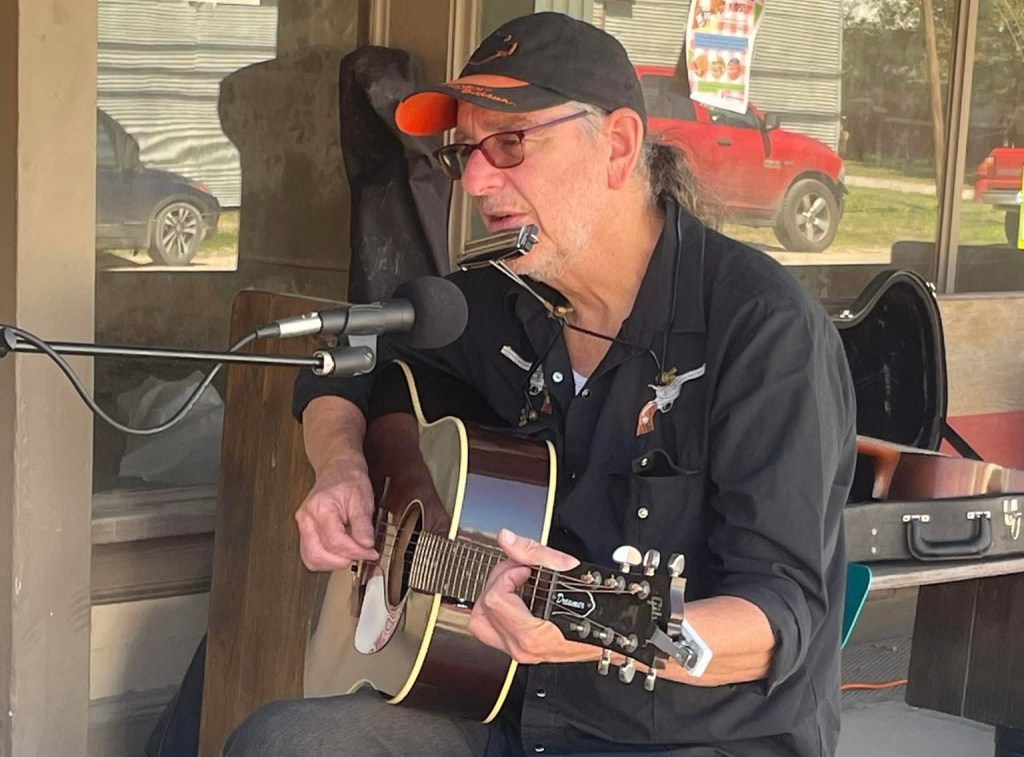
There’s no skipping over him, or being unaware of his presence in a crowded room. The energy he shares is soothing and lives in symbiosis, with his huge cheshire grin and his mischievously low baritone voice. Unfortunately, he is a Beatle (not a Stone). Fortunately, I got to kick it with him for a couple hours the other day and ask him some questions. He is a notorious San Martian, champion of songwriting, and my friend Missoula Slim.
Songwriting Journey
I had so many questions for Slim, but I wanted most to learn about his musical and song writing journey. I also wanted to pick his brain about his processes, motivations, and wisdom gained from his over 50 years of songwriting. I started by asking him about the beginning, about when he got “bit by the bug.”
“When I was probably 15 is when I first heard someone play the acoustic guitar. It was my brother in law, lived in Missoula, which is the cool town in Montana. And I went, Oh my God! That is the freakin’ coolest thing in the world! You know? Yea, I started making (expletive) up about age 15.” He got his first guitar soon after.
Talking with Slim, It seemed to me that his journey began as an infatuation, like a quest for some musical mountain top somewhere (or across a Strawberry Field or whatever those Beatles people are into). As we sat together, it occurred to me that he has no idea of the pedestal that I and many others place him on.
Cheatham Street Music Foundation
Slim has written several hundred songs. He is a lawyer and a proud cat owner. He is also the president of The Cheatham Street Music Foundation. The foundation was started by Kent Finlay to encourage and support songwriting in the Central Texas area. This foundation now supports two songwriter nights as well as a school for young aspiring songwriters.
“I’ve always been fascinated by songwriting. I mean more than anything,” Slim said.
He poured for me one of the best cups of coffee I’ve had (he even had a milk frothing machine). He described being influenced by the works of Bob Dylan, Neil Young, and a guy named Stewball. He said he listens to mostly jazz or classical while working. I told him I had heard some of this music as well. We toasted to our sophistication, then I asked him about his songwriting processes.
“While the lyrics are the thing that really drives me, as far as songwriting, the melody is just as important. I look at it in two basic categories. Outside-in and inside-out. The inside-out song…you come up with this great idea, and the song, more or less, writes itself. These are pretty rare,” Slim said. “The other songs are outside-in. Where, you kinda get an idea and play with it. Eventually, you kinda figure out what it’s about. Sometimes, you throw away the best parts or the best lines because they don’t fit what the song has become.”
Taking Notes
As we drank our coffee, Slim told me that he stores a list of song ideas or titles he has come up with in his phone. He told me that he writes songs in many different ways. Sometimes an idea first, sometimes the melody, sometimes a lyric.” You kinda reinvent the wheel every time you write a new song. You’re just coming at it from a different angle, but the process itself is still the same. You can come at a particular song in lots of different ways. Sometimes, you grab it by the tail first. Sometimes, you grab it by the head. Sometimes you have a whole idea… then you are just sketching it.”
Slim told me he believes it is important to use both sides of our brain when writing a song. He has labeled them “the fountain and the editor.”
“You gotta let the fountain go!,” Slim said, “and yea, you’re gonna lose a lot of water sometimes. Sometimes, you gotta let the fountain go without the editor slamming you down every time, but then you have to let the editor take that and come up with something cogent. Part of being the editor is getting outside yourself. What would an objective third party looking at this think?”
Knowing Your Audience
That led us into discussing the audience, or listeners. We talked about the way things are changing. How it is becoming harder and harder to make a living as a songwriter, that the listener has so many options to navigate. They also now have the option to listen to music created by artificial intelligence. I asked him if A. I. will ever go number 1.
“Absolutely! On every level, in every form, and especially in the performing arts,” Slim said. “In film it’s gonna be even worse, because actors are gonna become irrelevant. You’re gonna see a new Humphrey Bogart movie soon, I’ll bet. But, someday people are going to realize… A.I. can never be you! It can never. It will never be able to pick up a guitar and play it with nuance. A.I. can never sing and connect with an audience. A.I. can never look you in the eye, just at that moment, and deliver it. You know? That’s why I talk about Walt Wilkins. He is so good at making that connection.”
Teaching His Craft
Through the Cheatham Street Music Foundation and his other musical endeavors, Slim has had the opportunity to listen to and mentor many songwriters of all styles and age groups. Now and then, he witnesses a “lucky one” shoot out into the stars, but this being so rare, I asked him for the “tough love” advice for the budding songwriter. About the misconceptions or traps that set them on the wrong path.
“One trap is thinking everything you write is great. That just because you (expletive) it out, other people are gonna think it’s brilliant,” Slim said. “The idea of ‘I wrote it that way and I’m not even going to consider any rewrites.’ Or even more extreme: Don’t you dare give me any kind of criticism. I wrote it the way God gave it to me, and that’s as perfect as it is. That is a huge trap. I will listen to anything anyone says about any of my songs, and if it’s good advice, I’ll take it.”
I asked him again about the “hard truth”. He told me “everybody is unique, and that’s what’s cool about songwriting. If you are following your heart, you will be utterly unique. Your songs will be completely different than anyone else’s songs. Which is amazing! But, Don’t think that you’re (expletive) unique! Cause there’s a lot of people doing this, and it’s hard. It takes a special type of person to do it for a living. I never was. I never will be.”
“You have to have a certain ‘X Factor’ to make it as a professional singer songwriter/artist. Don’t think that just because you have talent, you’re gonna be a big star,” Slim said. “I read an article or interview with Bruce Springsteen where he said something like ‘you have to be a bit of a killer, kind of a shark. You have to want to be a star more than anything else in the world.’”
Final Words
I can’t recommend having a cup of coffee, or a song swap, with Missoula Slim enough. He will never realize (or admit) his impact on the songwriting community here in the Hill Country. He has around two hundred songs on you tube. He has two wonderful albums: Missoula Slim 9 and Missoula Slim Friends You Haven’t Met. He is truly one of my Super Heroes of Song.
He can be seen and heard all around Central Texas at his own gigs and at numerous song writing circles. You might come across him on a porch, or in a dive bar, or winery, or around a campfire, or in a listening room. You might find him in a circle with other artists, passing an invisible microphone around saying “I got one. this one’s about…” If you’re brave enough, you should come join us, and play one from your heart, or just listen. I promise when the song is over, you will look over and see Slim with one of the greatest smiles I have ever known.
More information on Missoula Slim can be found here.
Patrick Sullivan is a Texas based singer-songwriter and author of SUPER HEROES OF SONG, a column about artists.
Subscribe with your email below for our latest stories.

 Quality Americana
Leave a comment