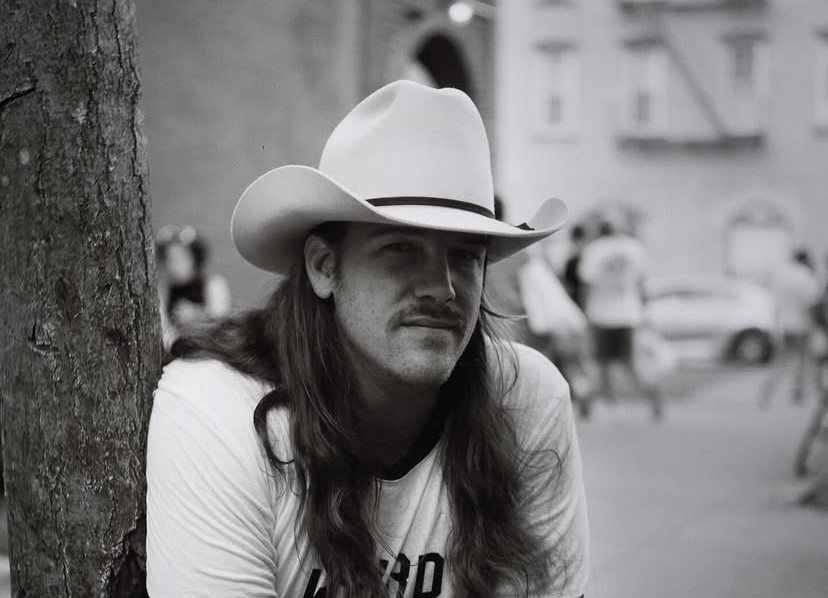
“Sonora,” a western-noir offering by Austin, Texas based songwriter Chasen Wayne has a Southwestern feel filled with an odd anticipation. The haunting guitar and Southwest aesthetic takes you down I-10 on a wild ride.
Small Town Life
Wayne was raised on a team roping ranch in Kennedale, Texas outside of Fort Worth, and later moved with the family to Granbury, a small town filled with songwriters and farmers.
“It was a pretty tumultuous childhood,” Wayne said, ”but most small towns are. You go like fishing, there’s lots of drugs around, lot of like your friend’s dads getting out of prison.”
His father worked long hours as a plumber, and eventually started his own company in the trade while also working at West Side Story, a three story dance hall.
“That’s where he met my mom,” Wayne said.
Finding the Music
Wayne got into trouble at an early age with his parents for his obsession with music. At the time they had saved up to buy him an XBox, but after a few short months it disappeared.
“I sold the XBox to my friend Tom for cheap, for like a hundred and fifty bucks,” Wayne said with a laugh. “It was just enough to buy the bass amp. Not only did I sell that X Box for way under what it was probably going for, I also spent way too much on this cheap bass amp.”
Wayne became a music nerd, studying Jazz and progressive rock as well as traditional blues.
“My first CD case, the first music that was like my music at ten or eleven, was pretty aggressive, which kind of fit for what environment I was living in, what my home life was like,” Wayne said about bands like Ice Cube and Pantera. “As I’ve gotten older I’ve gotten softer. I’m a dad now, that does a big number on how hard and angry you feel.”
Leaving Home
Wayne was restless in High School and applied to graduate early. He collected enough credits to leave for steady work on a ranch with cattle and wild game.
“Big Dallas lawyers put on a ghillie suit and sit in some blinds and hunt deer, which is sad,” Wayne said about his former employer. “The other side was black angus, raising beef. It was ranching which is what I was coming from anyway.”
He later set out for Austin at eighteen with his bass guitar in hand to make it in a rock band.
“I was a finger style blues guitar guitar picker like Skip James and Blind Willie McTell, Lightning Hopkins stuff,” Wayne said. “That translated alright to bass and rock and roll.”
Life in the Entertainment District
The band members found jobs in security on Sixth Street, the famed strip in the heart of Austin that’s home to the entertainment district. It was the long hours Wayne put in managing security that helped him find work at some of the largest venues in town.
“I took the job really seriously,” Wayne said. “My dad was a bouncer in Fort Worth.”
Through his work in security, Wayne took a position at Stubb’s BBQ, one of the largest stages in Austin that has seen legendary performances in their outdoor venue. Wayne’s health was starting to be impacted from the ranching he was a part of growing up, and the long hours offered little time to heal. He left the nightlife of the Live Music Capital of the World and decided to finish college for his plumbing certificate. Eventually Austin called him back and Wayne took on positions at several night clubs.
“I was digging tunnels for a plumbing company during the day, and then I would do that at night like three or four nights a week,” Wayne said. “I was young enough and physically capable enough to where I could handle it.”
There was a period of time where Wayne was entering the world of Hip Hop.
“I taught myself how to rap pretty fast,” Wayne said while he was also performing acoustic shows. “Rapping about like dirty trailer park (expletive). People liked it, I was getting attention from like whatever local hip hop scene you want to say, but even like owners and staff would get me to rap with them at parties or when we were closing. There were some local hip hop acts who liked my beats and invited me to their studio. It felt like for a minute there ‘I was like, am I about to be this white Texas rapper?’”
Eventually the unspoken temptations of the lifestyle caught up with him, what’s required to keep you awake for such long shifts and the chaos you’re encountering on a nightly basis with alcohol infused tourists.
Booking the Honky Tonks
Outside of the entertainment district once seen on MTV’s The Real World, Wayne found a solid crew to work for at the Sagebrush with Dennis O’Donnell that removed him from the chaos. O’Donnell gave his five piece band a stage, as well as a position at the club.
“I was doing day labor at Sagebrush, like helping with the AC work and patching roofs and mowing lawns, cleaning the venue in the morning, and then I would work at night there,” Wayne said.
He eventually worked up the courage to ask O’Donnell for a chance to take over booking for the club.
“I don’t know where the idea came up but I just thought I could book good bands,” Wayne said.
His first big nights came with a local benefit for the Health Alliance for Austin Musicians, and with country acts Nikki Lane and Vincent Neil Emerson.
“He was like ‘job’s yours, here’s your control of the calendar so start figuring it out,’” Wayne said. “I want it to be as much my place as it is theirs one day, but it’s not beyond me that the foundation that Dennis laid from Hole in the Wall twenty years ago, White Horse the last thirteen years, to now, it’s a pretty comfy foundation to build on. That foundation was built by Dennis.”
The Sagebrush is now an essential part of the dancehall highway that stretches from Nashville to Austin with country and Americana artists performing fresh off the road, and Wayne has embraced the family life after quitting the alcohol and stimulants cold turkey.
“I had to rebuild the band,” Wayne said, though some of the original members stuck around. They work to incorporate bossa nova techniques and other unique influences into their country sound. “It was a way for me to branch out. I was nervous about trying to play all these jazz chords and progressions and still trying to make it country and entertaining. When I put it out, that’s the stuff that people really responded to.”
The group just left New Orleans after performing at Jazz Fest, and have toured all across the country in the past few years. “I feel like we’ve finally arrived where this is the band. What you’ve heard on the last two records is the guys I play with if I’m going to go play a show.”
Sonora
Sonora tells the story of a car accident Wayne had while still abusing alcohol, and is told through the lens of a struggling traveler making his way through the desert.
“I think that one has legs,” Wayne said. “Sonically that’s the direction we’re going as a band.”
The main character is running away from the problems caused by these vices. The instrumentation builds up to the moment and lets you feel the impact.
“All my music is probably 85% therapy and 15% imagination,” Wayne said, “and the imagination part of it is just so that I can talk about these things.”
Substance abuse groups and therapy, as well as embracing his faith has given Wayne a new lease on life. He’s removed the reactive behaviors that he once used to cover up trauma, and now can confront the feelings head on.
“There’s moments in that where I’m still really touching about my life the whole time, it’s just dropped in poetically and just scripted enough to where you probably wouldn’t know how much of it actually is me unless we had this conversation.”
Support the Artist
More information about Chasen Wayne can be found here.
Subscribe with your email below for your Song of the Day.
 Quality Americana
Leave a comment