Kerrville New Folk: Directions in Americana
by Lindsey Eck
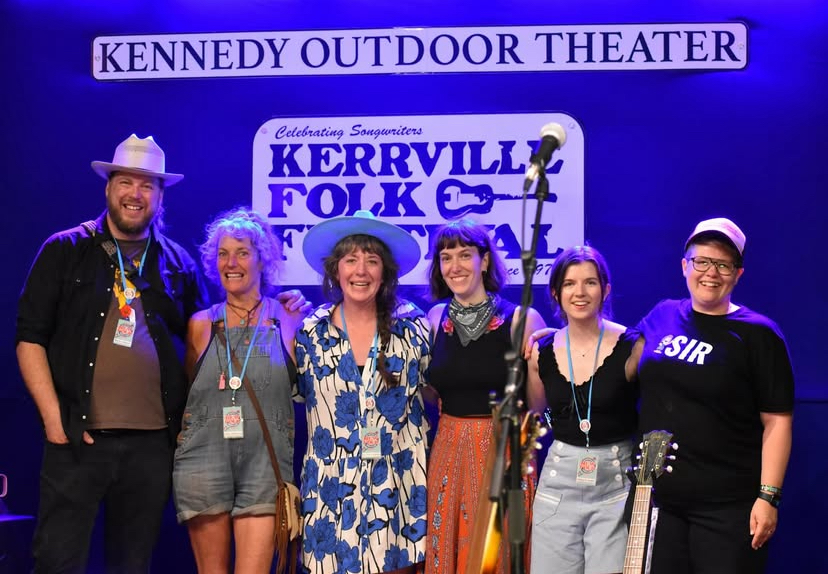
Though officially a folk festival, Americana is really more the vibe these days—more James McMurtry, less Judy Collins. The judges, ay it’s about excellence in songwriting and not genre, and this year’s songs were consistently excellent. But it’s also about what represents the historic legacy of North America’s longest-running folk festival while pointing to new directions in original acoustic music.
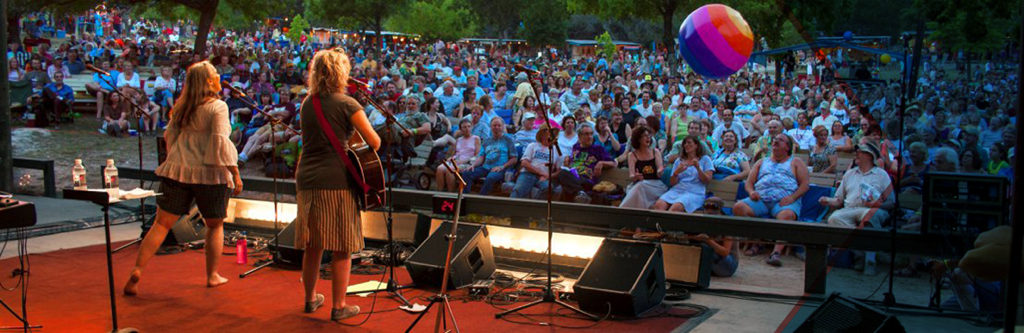
Kerrville selects six finalists from 24 competitors, culled from hundreds of recordings submitted by eager entrants. Each performs two songs live before a rapt audience in the Threadgill Theater. Judges evaluate the songcraft and performance.
“How folk it is doesn’t matter to me,” says Raina Rose, one of this year’s judges. “Do they believe their song? Does it accomplish its task?”
Each of this year’s finalists not only exhibited musical excellence, but brought a fresh approach to the meaning of Kerrville, Nashville, and Americana styles.
Canadian Madeleine Roger combines luscious melismas with a fluent fingerpicking style. Her rich, pure voice has remarkable clarity. Her folk roots are evident, but one hears echoes of Joni Mitchell. She was enthusiastic about the festival. “The most magical week of all time. I’m just so full to the brim.” Like most of the finalists, she can’t avoid the gravitational pull of Nashville, as one of her songs was about being a Canadian and visiting the Music City.
Finalists are allowed to perform with a partner, but for Sarah Beth Go her partner is a giant video screen showing her own stop-motion animations synched to her live performance. She works as a therapist in Nashville, which surfaces in a song about “little white pills.” One of her more amusing songs was about her accountant quitting on her. A Belmont graduate, she had a publishing deal after college, but he career was a bit stagnant. “And then I shifted into my career in counseling, and that’s when I got a message from Tim McGraw’s group and they had released a song I had written with friends.” It dropped in November; she made a bit of money off the song but also from a stop-motion animation she made for the song. “I watched people like Tim Burton and people who did claymation and it was always inspiring.” In Nashville, “I tried to fit a certain mold, and I didn’t. It’s places like these that allow me to explore and feel comfortable in what I’m doing now.”
Katie Dahl’s songs draw strength from anxiety. Several of her songs are, you might say, in the second person: She writes about having been a Jodie Foster stan (“we were basically twins”) and an intense intellectual attraction to a professor. She was joined on stage by Karen Mal, another idol turned mentor. Her moving tribute to her husband reflects her surprise at finding heterosexual love after a lifetime of being mainly attracted to women. “He is a river / He’s cool and deep.” Her well structured songs are definitely in the Americana tradition, and she knows just where to put the minor chord.
Abigayle Oakley grew up in Vegas, where she was part of the Rainbow Company Youth Theatre, but has spent the last seven years in Nashville. Was the move a culture shock? “Not really—they call Nashville Nashvegas.” Straying from the well worn paths of folk, her songs make use of some intriguing dissonances. Her voice is somehow both high and sultry, with a wide range and fluent melismatic singing. Like other Nashville-based finalists, she is outside the Nashville bro-country mainstream—but she’s making a record with Anthony De Costa. She rejects the Americana label and calls herself “existential indie folk.” “Folk isn’t a genre; it’s a community.” That encapsulates Kerrville so perfectly, the festival should adopt this motto.
Nashville is home base for Cindy Kalmenson, who is affiliated with Girls with Guitars, a sort of boot camp for girls to spend a month in intense guitar instruction. She sounds Tennessee, with a confident delivery. One song that wowed the audience had the refrain, “I was playing for keeps / not catch and release.” Her subjects reflected what we expect from Tennessee—guys who drink too much whiskey—but with an ironic, contemporary wit. Another one that the audience loved was about a “midlife Chrysler.”
Martin Gilmore teaches songwriting at a private institute and bluegrass at the University of Northern Colorado. Having grown up in a small town in Wyoming, he knows the loneliness of cowboys. He was the only finalist writing about his own family, a mainstay subject in prior competitions. His songs don’t reflect his bluegrass background per se, but his chops were evident in a fine solo. “I think a lot of the subject matter I write about is kind of more of the bluegrass era.” Gilmore stands out in his Old, Weird America approach, where the other writers are from the New, Weird America.”I try to write songs that aren’t necessarily for my voice—songs that I could see other people covering.” Maybe so, but his performance evidenced a fine baritone,
Having followed the New Folk competitions for many years, I can report that this year’s winners are gently pushing the boundaries of original acoustic music, carrying the torch of Nashville-adjacent divas such as Margo Price and Kacey Musgraves. Musically, the songs are getting tougher, with surprising deviations from the old I–IV–V format. Lyrically, the songs are intelligent and mostly addressing contemporary realities rather than Old Dog Trey. The future belongs to the divas, with five women and just one man among the finalists.
If New Folk is any indication, the route ahead for acoustic original music feels smooth and fast. The train’s leaving from Kerrville—all aboard!
Support the Artists
More information about the New Folk contestants can be found here.
Subscribe with your email below for your Americana news.
 Quality Americana
Leave a comment