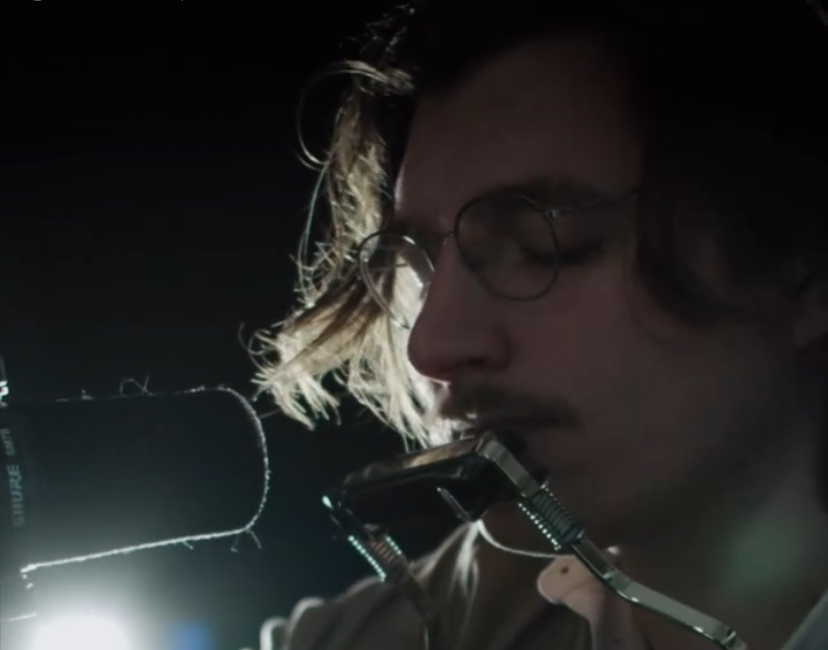
“Bells” by Eli Waltz is a masterclass in the folk craft. The layers that build up to the howls in the chorus are powerful, and the vocal style stands out as unique in a genre where it’s all been done before.
The epic feel of the recording is something we haven’t seen since Buffalo Kin, and is a rare find to hear with this quality. Often its form is mimicked in the top 40 country charts without the depth presented here. We caught up with Waltz, who first appeared in Quality Americana last year in our Song of the Day EP. 30 to talk about the new release.
Facing Mortality
The single discusses mortality, that first moment when Waltz became aware of the nature of death at just ten years old.
“I began to appreciate what it actually means, or what we don’t know it means when somebody dies,” Waltz said. “I was just hit over the head as a ten year old. I just got extremely panicked by this idea. It was terrifying, the cessation of things.”
Waltz had a panic attack when this information became reality, and he quickly started asking his family members about their thoughts on mortality.
“They didn’t give me a satisfying answer,” Waltz said, “but I do remember my Dad, he was just very real with me. He’s a neuroscientist, so he has a good perspective about consciousness and brain activity.”
His father described the process of the loss of motor functions that occurs when one dies.
“When you die the brain decays,” Waltz said. “He told me that he thought that it’s like it was before you were born, and I appreciated it. At the time it was extremely concerning, but I really appreciated his honesty.”
In the following weeks and months, Waltz had an epiphany and accepted that death remains a mystery.
“It was unexpectedly comforting,” Waltz said.
Bells
Waltz co-produced “Bells” with long-time friend and collaborator Hannah Wyatt. It was another song recorded long-distance with our modern technology, and the collaboration stretches from Bellingham, Washington to Switzerland. It’s amazing that the song only contains two artists.
“We both play multiple instruments,” Waltz said. “When you combine two music nerds, the possibilities are endless.”
Waltz has shown his musical diversity with “Bells,” progressing his production and instrumentation beyond his previous releases. His music has a Yin and Yang aspect to it, where some songs dive into the darkest thoughts and others focus on the immense beauty in our lives.
“The lesson that I continue to hold very dear is like a philosophy,” Waltz said. “It’s very over said and done, this idea of seizing the day – carpe diem, and life is short and all of these platitudes, but it really was profound for a ten year old. I think it really does influence how I aspire to go through a normal day. I sometimes fall short of seizing it, but it is words that I try to live by.”
Waltz moved from the East Coast to Switzerland last year, and recently finished his first tour of the continent including the United Kingdom and Ireland. The idea of a finite existence on Earth led Waltz to where he is today, traveling the world in the pursuit of human connection and writing songs about the deep philosophical topics that have been asked for generations.
Influences
Waltz’ vocal stylings remain a mystery, a collection of dialects he’s encountered in the United States, Europe and Mainland China.
“All I know is what I really like listening to, but there’s something different between what I like listening to and influences, so to speak,” Waltz said. “After I played in Derry, in the north of Ireland, some dude I was talking to after the show was trying to get across to me how much Irish influence he thinks there is in the majority of my music. It was kind of like this ‘ah ha’ moment. He was completely right. There’s a lot of Celtic influence. So much Irish influence comes into American music with bluegrass, and that old Appalachian music and country music, so I guess it’s no mistake.”
Waltz has been heavily influenced by Dave Van Ronk, who pulled from many traditional folk stylings while building a name in the New York folk explosion in the 1960’s. The traditional folk stylings remain a constant throughout his work.
Support the Artist
More information about Eli Waltz can be found here.
More information about Hannah Wyatt can be found here.
Subscribe with your email below for your Song of the Day.


 Quality Americana
Leave a comment