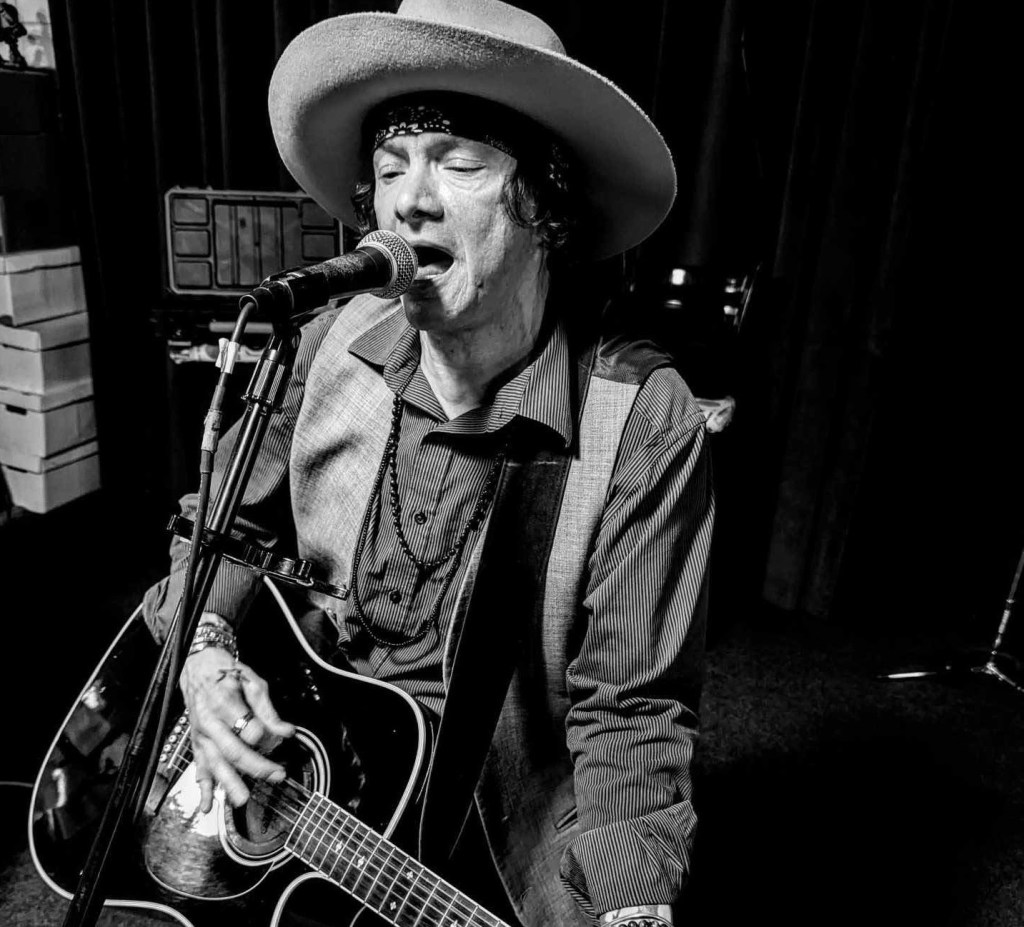
REFLEXIONES Vol. 1 – The Love and Irreverence of Xavier Aguirre, A Pioneer of American Glam.
by Nathanial A. Barrera
Not all of us were meant for “normal.”
Xavier Aguirre, the guitar virtuoso, just smashed his left ring-finger good and proper while shutting a window in his lovely San Antonio home. In a moment, the pad of his finger developed a large, purple welt that’s sure to be both painful and highly inconvenient.
As if he isn’t facing nearly an entire month full of gigs beginning in less than a week, the iconoclastic maestro watches the bruise on his fret-hand as it grows. Wearing an audacious grin, he releases a forgiving sigh, shrugs his shoulders and says, “welp, that’s Rock n Roll.”
The wound on his hand will prove no obstacle for Aguirre. He’s far too deep in love with what he does and far too familiar with life’s peaks and valleys to stumble now. At the age of 55, Aguirre is by far one of San Antonio’s most prolific and dedicated artists, showing no loss of stamina and no signs of slowing.
Aguirre has opened for the likes of Bob Dylan and Paul Simon, worked some damn fine race horses, written, performed and recorded a plethora of fantastic, unique music, exchanged his used kidney for a new one and, in the aftermath of a life-changing stroke, was somehow able to re-learn walking, talking and playing guitar. Toss in more than a decade of solid sobriety and suddenly his relaxed demur shines in a different way. Aguirre has been to Hell and back, and since the man is clearly a searcher, I wouldn’t bet on ever catching him in the same place twice.
“My cup isn’t half full or half empty,” Aguirre said.“The way I see it, my cup is overflowing.”
Growing Up in San Antonio
Aguirre first met music in a way that’s as idiosyncratic as the man, himself.
“I was like eleven or twelve and I was trying to be cute for some girl, so I called into KTFM to request a song for her,” Aguirre laughed, “but when I finally got through, they said I was ‘the second caller’ or something and told me I had just won two tickets to see Rick James. I was so young, it’s not like I knew that much about Rick James, but my older cousin Liz took me and, boy, the second he hit the stage I was mesmerized: absolutely mesmerized.”
Although that night certainly caused some sparks in his soul, his father and his family kept his eyes focused on their construction company, training and breeding racehorses throughout the Texas Hill Country and his dad-ordained vocation to become an architect and nothing else.
If there is at least one reliable truth concerning this road called life, it is that it often prefers its own inclinations, twists and turns much more than it cares for our plans.
On December 19, 1984, Aguirre’s father Gilbert, a force of a man, suffered a major heart attack while he was training horses and died right there on the racetrack.
When Gilbert passed, a lot went with him. Along with his family’s stability and security, the horses, the ranch and his plans all seemed to evaporate. Only fourteen years old at the time, the youngest of six siblings, Xavier was left brokenhearted and without direction.
“About a week after my dad died, it had to be the 24th or 25th of December, I remember lying on my bed, staring at the ceiling and wondering who I was supposed to be, now,” Aguirre said.
Last Gift
Then, something seems to have clicked in his mind. Although his specific reasons are still something of a mystery, Aguirre’s father had given him a very special gift no more than a week before his passing: a classical guitar made by Yamaha.
“By the end of that week, I was completely submerged.” Aguirre said. “Totally dedicated to it.”
While the enormous neck of any self-respecting classical guitar would have sent most other teenagers running for the hills, Aguirre was relentless and adaptable. By March of ‘85 his obstacles had become his advantage and by the time he was able to get his hands on a 1973 Fender Stratocaster. It was “like going from black and white to playing in color.” Before the end of the year, Agguire was playing paid gigs and backyard shows throughout the city.
“My poor mother,” Aguirre said with a sympathetic chuckle. “She worked during the day so I would literally get up, go to school for a while, come home early and just play guitar all day. I would fall asleep with it.”
By this time, habitual trips to the downtown public library had widened his musical palette. Here, Aguirre discovered Linda Ronstadt, Mozart, Black Sabbath and, perhaps most significantly, The Rolling Stones.
“It was over once I heard ‘Wild Horses,’” Aguirre said.
Via Keith Richards, Agguire discovered Gram Parsons and his catalogue, and then David Bowie, and then T. Rex and so on and so on.
“At that time, all I could think was ‘this is the greatest job in the world,’” Aguirre said as he recounted the years. “ All I could think was that this was all I ever wanted to do with my life.”
From his musical and personal influences, to his various groups and projects, to the way he presents himself both on and offstage and even down to the way he has overcome such severe physical maladies, everything about Aguirre alludes to another world, one much larger than our own. He is voluminous and always unafraid, and his resilience is biting. Aguirre is the embodiment of an audacious glamor that refuses to be bothered by adversity.
“My dad would always tell us ‘if you’re going to do anything, you better be the best at it,’” Aguirre said. “I’ve hit a few curves along the way, but it’s always come down to this whirlwind romance I’ve had with the music.”
What’s more, Aguirre’s creative fire is far from burnt out.
“I’m so excited for the rest of my life,” Aguirre said, once again wearing that grin. “I’m making music every day, I’ve got a beautiful family, wonderful friends, I’m sober, I’m married to my best friend. I mean, come on, man, I’m on top of the world.”
Aguirre also gave some advice to aspiring musicians:
“I always believed that the best way to make my heroes proud, to make my dad proud, was to recognize their legacies, but make sure and leave my own mark right up next to theirs,” Aguirre said. “I’ve always just wanted to give back to this thing that I’ve loved so much. Be sure to recognize your own impact on all this and be sure to throw in your own story. Not all of us were meant for “normal.”
REFLEXIONES is a weekly column by Nathanial A. Barrera
Subscribe with your email below for our latest content.



 Quality Americana
Leave a reply to Bobby Kinsel III Cancel reply