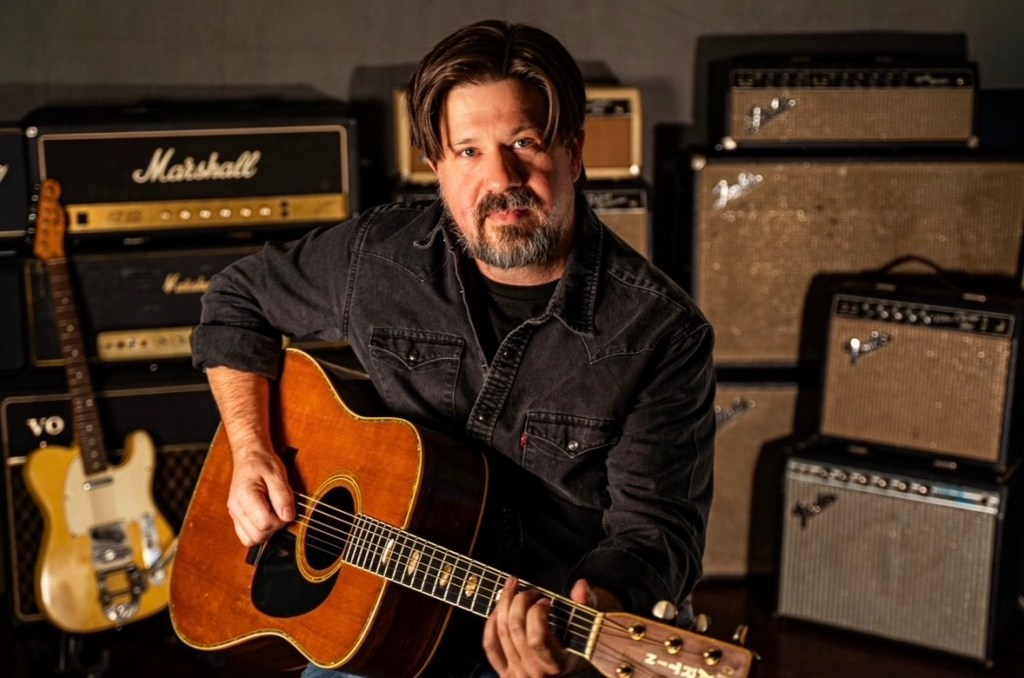
By Patrick Sullivan
Instrument: Dobro and Guitar
Lair: His Kitchen
Beatles or Stones: Stones
Greatest Influence: His Mom and Slash from Guns and Roses
Keith Davis is a roofer and a snake wrangler. He has been a minister and a sheriff’s deputy. I would say he has worn many hats, but I can’t recall ever seeing one on his head. Before, during, and after all of these endeavors he has been a musician. Davis may tell you he never had a choice, but I believe he would have chosen music no matter where or when he was put on this earth. Some people seem to have it in their veins or breathe it, pulling it from the atmosphere and exhaling it through their being. This is my perception of Keith.
I was very intimidated to meet him for the first time. I heard he was a producer and that he had played with famous folks all over the place. Then I listened to him play one of his original songs at my favorite place, The Redbird Listening Room, and I never wanted to play the guitar around him again, but I did anyway. His encouragement to me and so many others like me is the reason I felt compelled to include him in this series as a Super Hero of Song. I asked him about the beginning.
“I started out as a piano player.” Davis said. “My mom started me out in piano lessons in the second grade, and it’s one of the things I would thank her for and give her credit for because it made me the musician I am today.”
Keith is a multi-instrumentalist. I have seen him play all manner of guitar, including pedal steel and Dobro, but I have also heard him play the piano and sing beautifully. He recounted being a kid playing the piano at church and talent shows and around his family and friends, but I wanted to know when the guitar bug bit him. He told me the story.
“I remember I was in my room learning a Beach Boys song on the keyboard and my dad was working out in his gym next to my room and Sweet Child of Mine (by Guns and Roses) came on the radio,” Davis said. “Hearing the intro to that song changed my life.”
After finding his love for guitar and graduating from high school, Davis continued his musical trajectory at North Texas University where he studied Jazz guitar. Not too long after, he set his sights on a new kind of life.
“I dropped out of college to move to Austin to be on the road,” Davis said. This chapter in his life is truly what most musicians dream about, and I’m sure we could fill this piece to the brim with stories from that time, but that isn’t where I wanted to dig. He should write a book, because he has truly lived an extraordinary life. He simply put a cap on it by exclaiming, “I had a music career, you know, and I gave it up to be a normal guy.” I met him years after that life changing decision, after several careers and starting a beautiful family, and having kids and watching them grow. I met Keith Davis when he had come full circle, back to music but with something different in mind. He wanted to write songs and perform them from his heart.
“Time is finite,” Davis said. “The end is coming. I’m not afraid of it. I wanna spend the rest of the years I have on this planet doing something that makes me happy.”
I and many of his other fans are fortunate to be a part of his new mission. I asked him about his process. His perspective on this craft is rare. There are not many of us who have played the “big shows” and even fewer who have returned to search for the origin: The Song.
“I don’t listen to the radio unless I’m in New Braunfels,” Davis said. “Then, I listen to KNBT, because I like it,” I am always curious about this aspect of a songwriter’s inspiration. Some writers I know listen to music constantly. Others seem to believe it can steer them away from their individual personal expression. “Especially, if you wanna write something,” Davis said. “You gotta write from a place inside you, not what you’re hearing around, you know.” I kept pressing about his process, asking what happens first? He told me the song started in different ways for him.
“When you’re playing guitar and you’re messing around on guitar, sometimes you find something,” Davis said. “Like ‘Oh, that was cool!’ And that’s where the song starts.” Later he would tell me that some of his songs “started as titles.” He mentioned one of my favorite songs of his, Prettiest Girl In the Room, started like that. He said in his notes on his phone he has probably 30 titles that are just titles, but when they begin to become songs he can go back to the titles and remember what he wanted to do. This method of writing titles, or hooks, or ideas when they come to mind, seems to be very effective for many songwriters I know. As a sufferer of extreme bouts of writer’s block, these process illuminations are monumental.
We continued to discuss writing songs. He told me, “I am finally finding out how to write consistently. For me, it’s either first thing in the morning, last thing at night, or if I go see a show. He continued, “I’m triggered to write by other writers.” He told me he had recently seen a Mike McClure project that he is doing with his wife that had inspired him for weeks. Keith said when he is finally ready to write the song he uses Google Docs. “This is so terrible,” Davis said. “Guy Clark would be mad right now. I can pull it up on my phone. I can pull it up on any computer in America. In some ways I’m old school. In some ways I embrace technology whenever I can.” But after the song is written, it must be performed or recited.
Keith Davis is an amazing performer. One of the first things he told me in the interview (when we were discussing super hero stuff) was that his super power was making people cry. I wanted to know how he knew when a song was ready, and where he tried it out first. He answered, “I’ll get it to the point where it’s memorized. Then I’ll go to The Red Bird, or like when Bill Whitbeck was doing the speakeasy, or Middleton Brewing. I’ll go somewhere I have friends, I feel comfortable, I feel loved. I feel supported. Then I’ll put that song out there, and only then will I know, for sure, some questions about it.” He continued, “Like, how is the flow of it? Is it in the right key? Is it too fast or too slow?” He told me he plays every song he writes at a live venue two or three times until the final editing is done. “I have to be live, because you have to have a little bit of the jitters, and you have to have a little bit of reaction from the people. I need to be live to see what my voice is gonna do, to see if the key is right.” I agree that the listener response can be crucial to editing, and we agreed that some songs are better for some crowds as well as some venues. It is inconsiderate to not consider the who and where of a performance.
We continued to discuss performing original music. He added, “I’ve got three or four songs that I will only play at a listening room where there’s no talking because they will fall flat in a bar environment.” He told me his favorite way to share his music is at a song swap. “I’d rather do song swaps than solo shows cause there’s a back and forth. If you have to do anything in life, If you’ve got a buddy with you it’s better.” Keith is “buddies” with a ton of amazing songwriters from all different levels of skill and prestige. He also spends a great deal of time producing and promoting and sharing his stages with many of us. It is clear that he is not in it for the money. If he was he could easily get back on the road anytime. I wanted to know why he does so much for other artists.
He described some of his approach to producing: “I produce on a sliding scale. I’ve never produced anybody for just the money. I’ve always believed in the person I’ve said yes to. Hopefully someone will see something they like in what I do, and see my dedication, and hire me.” But make no mistake, the money is part of it. “Everyone wants to be famous, I wanna make a living. You know what I’m saying.” He told me, in the music business, you have to have a couple of different hustles. I asked him if he had any more advice, especially to young people who are thinking about getting into music and or song writing.
“I would tell them the same thing my mom told me, start with piano lessons.” He told me he would teach them, “Don’t be one of the million electric guitar players in South Austin. If you can play bass and sing, you can write your own ticket in this music scene.” Which led to my next question. About the music scene.
Keith has been a part of several different music scenes in his career, some of the largest and most famous in the world. I have a very limited understanding of these scenes and how they differ, however I am a small part of a local New Braunfels Texas Hill Country music scene, and it seems to me to be different than what I have heard of the others. Not as competitive. Not as saturated. Not as exploitative. I asked him if he thought ours was special? He answered, “this New Braunfels scene that we’re in, it’s not like that man. It’s like beautiful. It’s pure. It’s pure.” He talked about some of our fellowship and community. He said, “Iron sharpens iron, and now we’re all writing and recording. That’s a good scenario.” He told me that, “Sometimes, when I’m at songwriter night, I do feel like I’m saving money on therapy.”
As we neared the end of the interview, I asked him about the state of affairs in music, specifically songwriting. I asked what the problems were? What we should support? What we should avoid? And what does the future look like? He explained, “we can’t go back to people paying seventeen dollars for an album when they can get it for free.” He offered, “Supporting local house concerts and ticketed shows where people get paid right.” I asked him about A.I. He said “there’s no A.I. in my music. There never will be. If you use A.I. to write songs or help you write songs, you are not a songwriter, you’re playing video games.” Many of us believe A.I. could spell the end of songwriters as we know them, but Keith says it can’t do everything. “The only thing that A.I. can’t take away from me is the back and forth between me and you. The songwriter and the listener.
We finished the visit discussing spirituality and faith. I have a theory that most artists believe in some sort of higher power, and that many of them see it in their creations. I asked Keith Davis his thoughts on my theory. He had a few. “You just have to be open to there being something bigger than you,” Davis said. “When you’re bleeding out in the middle of the road and you’re dying, nine out of ten people are praying to God.” I feel God, even in the songs that are not about God.
If you ever see that Kieth Davis is gonna be playing somewhere, go check it out. You will not regret it. He is a wonderful songwriter and musician. He is also my friend, and a helping hand to many of us who dare to put our hearts on a stage. I’m glad he came back to music, and I’m glad he thinks of himself as a “normal guy.”
Support the Artist
More information about Keith Davis can be found here.



Leave a Reply